On this page
The short answer
If sun reaches your garage floor, put polyaspartic on top. It is UV-stable, so it holds its color, and it cures fast enough that most garages are back in use within a day or two. If the floor sits in shade, the budget is tight, or the slab has a moisture problem, epoxy does more of the work, usually as the base coat under a polyaspartic topcoat.
Full polyaspartic
Choose polyaspartic if
- The floor gets direct sun
- You need the garage back tomorrow
- The slab is dry and tests well
- Typical San Diego price
- $6–$10 per sq ft
- Typical install time
- Often 1 day
HybridEpoxy base, polyaspartic top
Choose both if
- You want sun-proof color on a budget
- The slab is older or tests damp
- You picked a light flake blend
- Typical San Diego price
- Upper half of $5–$8 per sq ft
- Typical install time
- Usually 2 days
Full epoxy
Choose epoxy if
- The floor never sees direct sun
- It's a closed garage, gym or shop
- Budget matters most
- Typical San Diego price
- Lower half of $5–$8 per sq ft
- Typical install time
- 2 to 3 days
Here is how the two chemistries compare on the things that decide how a garage floor looks in ten years.
Epoxy vs polyaspartic, head to head
- Color stability in sunAromatic epoxy ambers in UV; aliphatic polyaspartic stays clear.Epoxy 1 of 5, polyaspartic 5 of 5.
- Speed back in serviceOften a 1-day install and parking in 24 to 48 hours.Epoxy 2 of 5, polyaspartic 5 of 5.
- Abrasion resistanceData sheets: about 20 to 30 mg lost on the Taber test vs 50 to 90.Epoxy 3 of 5, polyaspartic 5 of 5.
- Forgiving to installPolyaspartic sets fast on the floor and speeds up in humidity.Epoxy 4 of 5, polyaspartic 2 of 5.
- Build per coat100% solids epoxy builds thickness fast.Epoxy 5 of 5, polyaspartic 3 of 5.
- Damp-slab optionsMoisture-mitigating epoxy primers exist; polyaspartic needs a dry slab.Epoxy 4 of 5, polyaspartic 2 of 5.
- Upfront costHigher is cheaper. Polyaspartic resin and labor cost more.Epoxy 4 of 5, polyaspartic 2 of 5.
- DIY friendlinessShort working time punishes mistakes.Epoxy 3 of 5, polyaspartic 1 of 5.
Want both systems priced for your garage? We quote them side by side after a moisture test.
Get a Free EstimateWhat epoxy and polyaspartic actually are
Epoxy is a two-part coating: a resin, usually based on bisphenol A, and an amine hardener. Mixed together, they cure into a hard, rigid plastic that grips ground concrete well. Professional floor epoxies are typically 100% solids, so nearly everything rolled onto the floor stays there, and one coat builds real thickness. That makes epoxy an excellent primer and base coat.
Its weakness is light. Epoxy resin is aromatic: its molecules contain benzene-type rings that absorb ultraviolet light. Over time UV breaks bonds around those rings and leaves behind compounds that look yellow, so an epoxy surface in the sun slowly ambers and loses its gloss. Indoors, out of direct light, that barely matters.
Polyaspartic is a newer two-part coating, developed by Bayer (now Covestro) in the 1990s. Chemically it is an aliphatic polyurea: polyaspartic ester resins react with an aliphatic isocyanate. Aliphatic means no light-absorbing rings, so it stays clear in direct sun. The ester chemistry also slows the polyurea reaction from seconds to minutes, which is what makes it possible to roll it onto a garage floor at all.
Where each coating comes from
Epoxy
The classic two-part floor coating; cures in hours
Why it yellows: aromatic rings absorb UV, bonds break, and the byproducts look amber.
Polyurea family
Isocyanate plus amine; reacts much faster than epoxy
Sprayed hot; sets in seconds; many yellow in sun
Aspartic ester amines slow the cure to minutes, so it can be rolled. Stays clear in sun.
Polyaspartic vs polyurea: same family, different behavior
Every polyaspartic is a polyurea, but not every polyurea is a polyaspartic. Classic polyurea reacts in seconds and is sprayed through heated, high-pressure equipment, which is why it shows up on truck beds and roofs. Many sprayed polyureas are aromatic and yellow in sunlight. When a garage company sells a polyurea floor, the base coat may be a fast polyurea, and the clear topcoat is usually a polyaspartic. Two questions matter more than the name on the brochure: is the topcoat aliphatic, and how thick is each coat?
How a coated garage floor is built
A garage coating is a system, not a single product. Each layer has a job, and the epoxy vs polyaspartic decision is really a decision about which chemistry does which job.
Anatomy of a flake garage floor
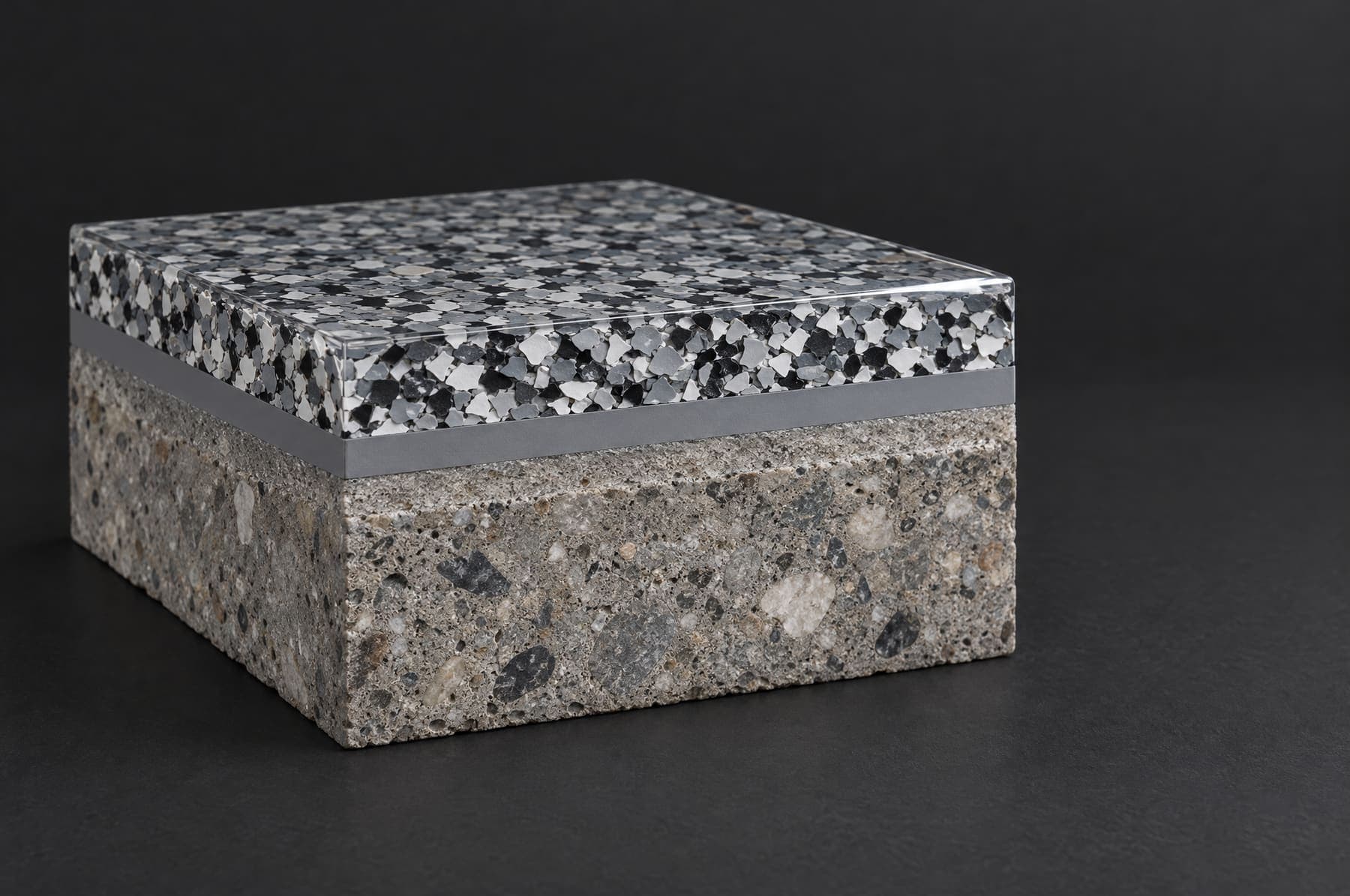
- Clear topcoatThe wear layer that tires and tools touch. UV stability and gloss live here, so this is where polyaspartic earns its price.
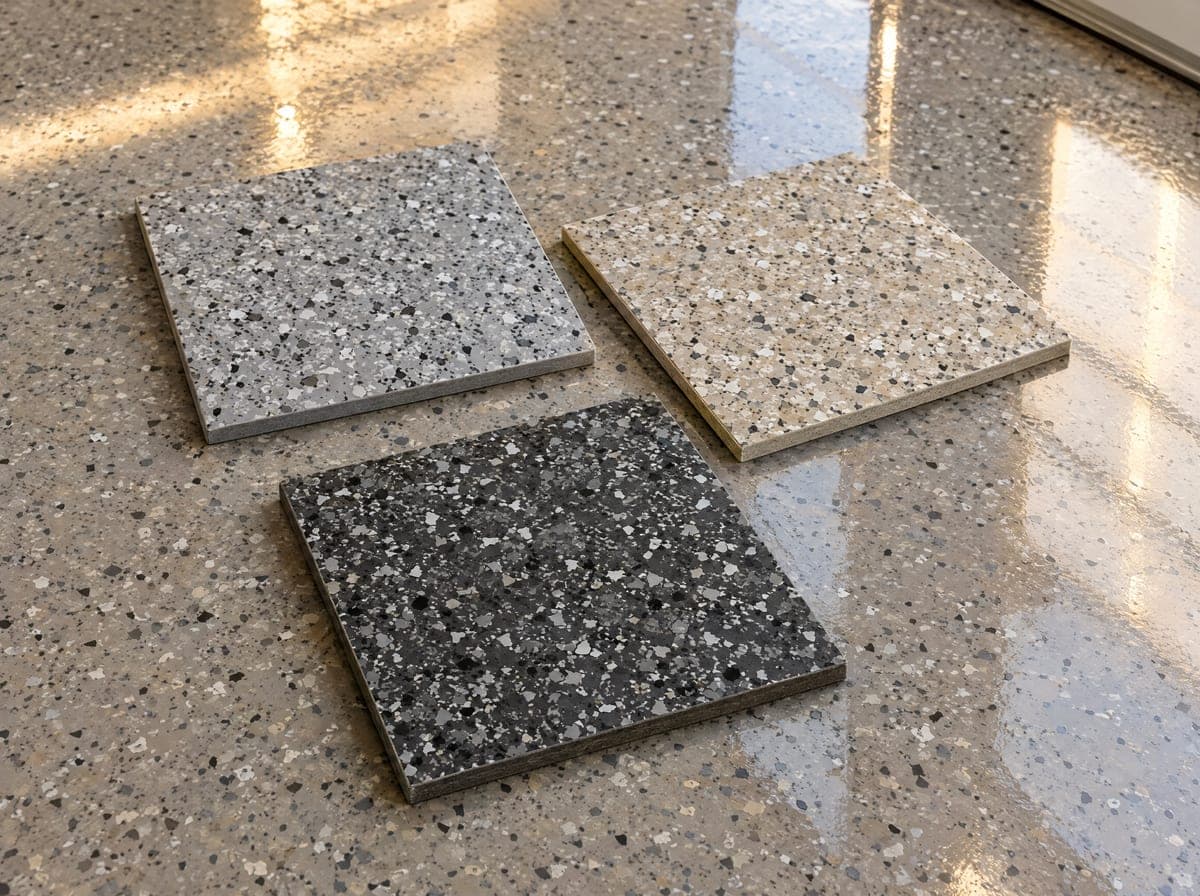
- Flake broadcastVinyl chips scattered to full coverage for color and texture. Hides dust, scuffs and small slab flaws.
- Base coatBonds to the concrete and builds thickness. Usually epoxy, or a moisture-mitigating epoxy primer over a damp slab.
- Diamond-ground concreteDiamond grinding removes the weak top layer and leaves the texture the data sheet calls for, typically ICRI CSP 2 to 3 for garage coatings.
Most garage floors use one of three recipes. They share the same foundation, a diamond-ground slab, and differ in what sits on top of it.
Three common garage systems
Full epoxy
- UV-stable topNo
- Install2 to 3 days
- Damp slabOK with primer
Hybrid
- UV-stable topYes
- InstallUsually 2 days
- Damp slabOK with primer
Full polyaspartic
- UV-stable topYes
- InstallOften 1 day
- Damp slabNeeds a dry slab
The hybrid in the middle is often the sweet spot for San Diego garages because it puts each chemistry where it is strongest: epoxy against the concrete, polyaspartic facing the sun and the tires. See how we build polyaspartic floor coatings and flake epoxy floors.
Sun and yellowing: the biggest practical difference
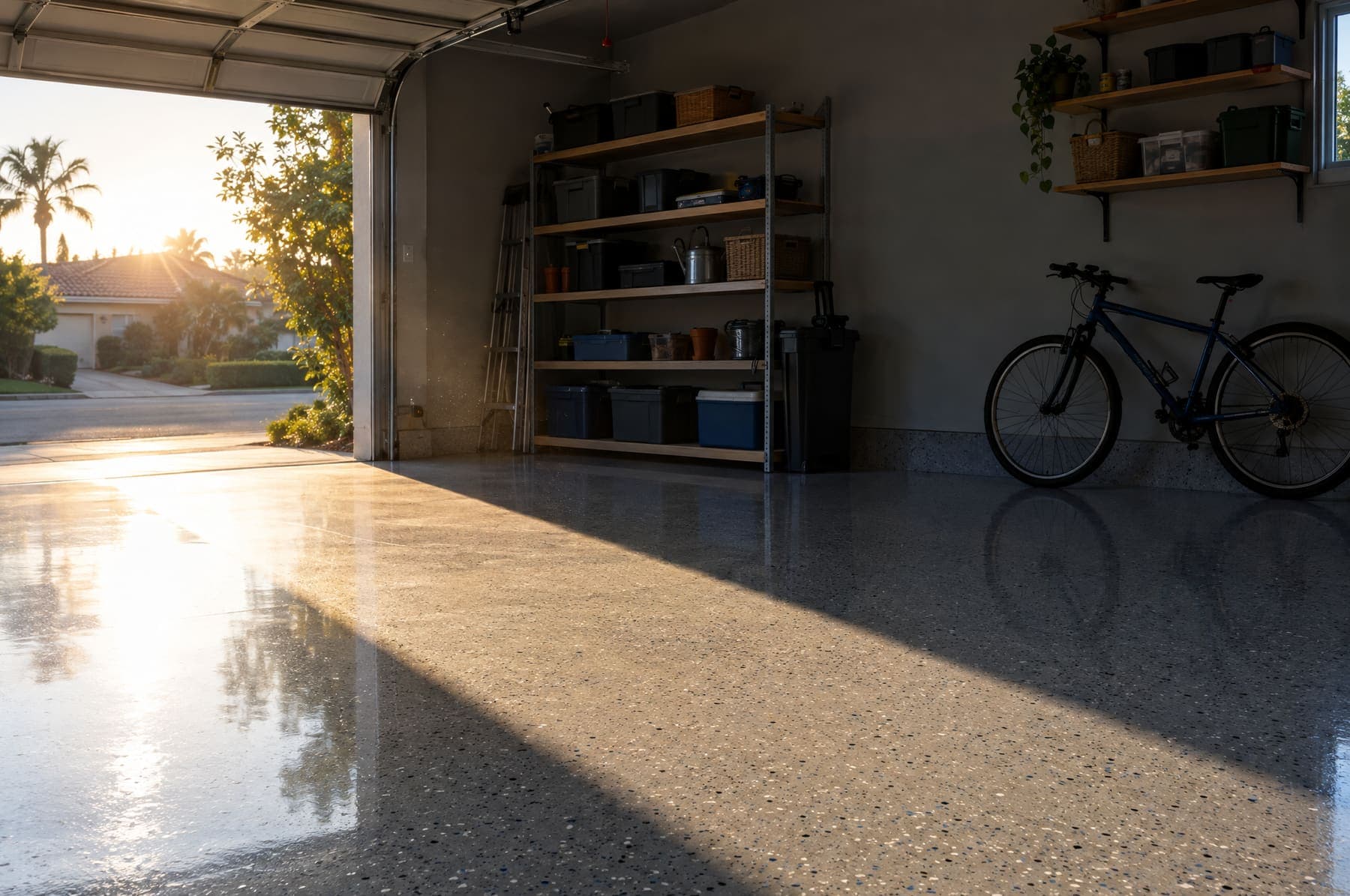
An epoxy topcoat in the sun yellows. Some products add UV absorbers that slow it down, but none stop it. A polyaspartic topcoat in the same spot stays clear and holds its gloss far longer. If any part of your floor gets direct sun, this one difference usually settles the topcoat question.
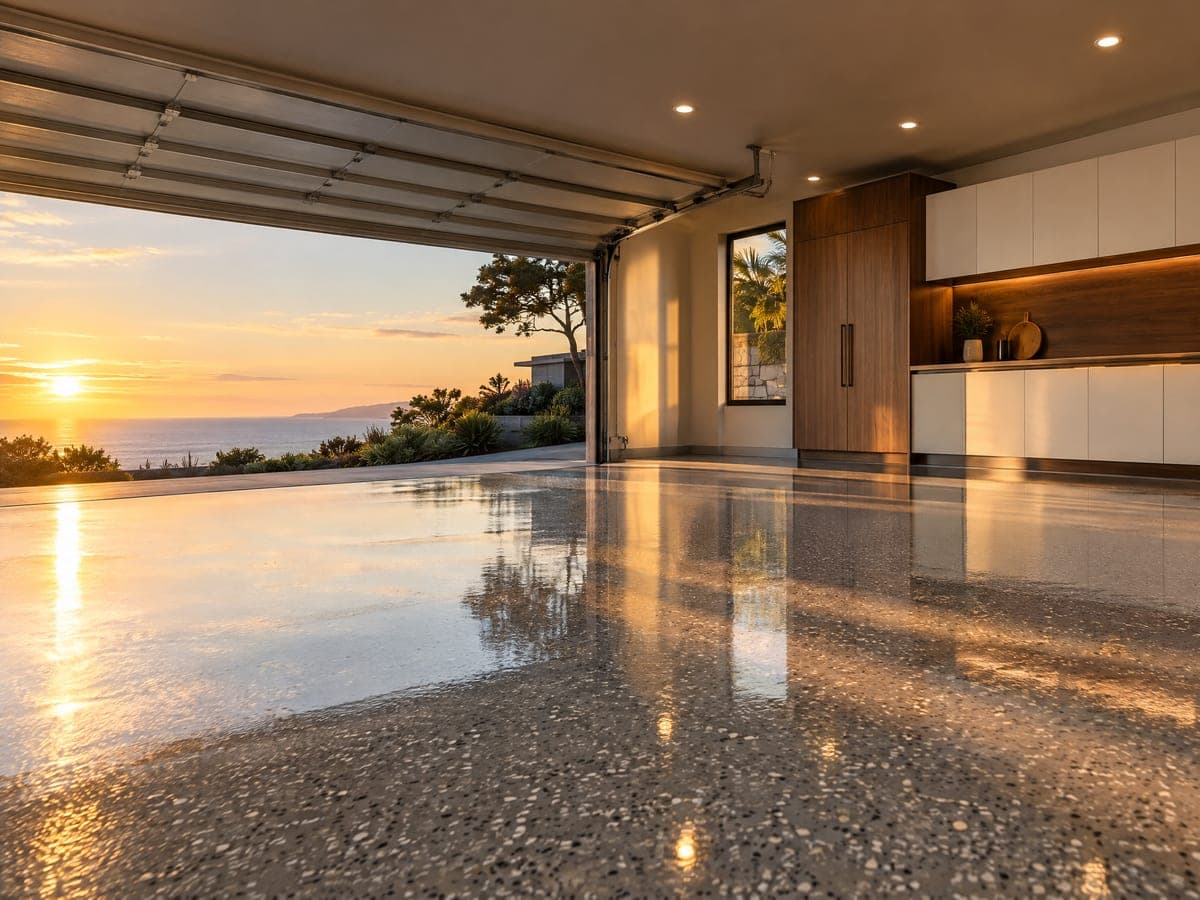
San Diego's sun is strong all year. In July the average UV index along the coast sits around 10 to 11, which the EPA rates very high, and May Gray mornings usually burn off by afternoon, right when the sun is low enough to reach into a garage. A west- or south-facing garage that sits open in the afternoon puts a band of direct light across the same strip of floor every day, which is exactly where an epoxy topcoat shows its age first.
Drag the sun: what years of exposure do
Inside a closed garage, a basement or a shop with no sun at floor level, yellowing is a much smaller concern, and a full epoxy system can be the better value.
Cure time: when you get your garage back
Speed is polyaspartic's other headline feature. Typical garage polyaspartics allow foot traffic in about 4 to 6 hours and vehicles in about 24 to 48 hours. Typical 100% solids floor epoxies need 10 to 24 hours before you walk on them and 2 to 3 days before you park. The bigger gap is the install itself, covered below. Pick a finish time to see what it means for your week.
When can you use your garage again?
- Polyaspartic
- Walk on: from about Sat 5 PMPark: between Sun 11 AM and Mon 11 AM
- Epoxy
- Walk on: from about Sun 11 AMPark: between Mon 11 AM and Tue 11 AM
Installation time differs too. Epoxy needs hours between coats, so a full epoxy flake floor usually spans two or three days. A full polyaspartic system can be ground, coated, flaked and topcoated in one long day when the slab is dry and needs little repair.
Durability and lifespan
Both chemistries make tough floors when the prep is right, but they wear differently. Polyaspartic topcoats resist abrasion better: on the standard Taber test, published data sheets show roughly 20 to 30 milligrams lost for polyaspartic topcoats versus about 50 to 90 for floor epoxies. Epoxy builds thicker per coat, often 8 to 30 mils at 100% solids, which helps it level small imperfections and makes it a strong foundation.
How each topcoat holds up in a home garage (Taber figures from published manufacturer data sheets; lower is better)
| Epoxy topcoat | Polyaspartic topcoat | |
|---|---|---|
| Tire lanes and grit | Scuffs and dulls sooner | Resists abrasion well |
| Taber abrasion, mg lost | About 50 to 90 | About 20 to 30 |
| Gloss in sun | Ambers and chalks | Holds color and gloss |
| Hot-tire pickup | Resists it when well bonded, thick enough and fully cured | Resists it when well bonded, thick enough and fully cured |
| Oil, antifreeze, brake fluid | Good; wipe spills promptly | Good; wipe spills promptly |
| Refreshing later | Sand and recoat | Sand and recoat with polyaspartic |
How long a floor lasts depends far more on prep than on chemistry. A professionally installed garage system with diamond-ground prep and a UV-stable topcoat typically lasts 10 to 20 years in a home garage, with the topcoat refreshed in the tire lanes as it wears. Most early failures, such as peeling, bubbling and hot-tire lifting, trace back to an unground or damp slab, not to the coating on the label. That is why we start every garage floor epoxy job with diamond grinding and a moisture test.
Cost: what each system typically runs in San Diego
Polyaspartic costs more per gallon, and its short working time takes a more experienced crew. In San Diego, an epoxy-based flake system typically runs $5 to $8 per square foot and a full polyaspartic system $6 to $10. For a 2-car garage of 400 to 500 square feet, that is about $2,000 to $4,000 for epoxy versus about $2,400 to $5,000 for polyaspartic.
Price your garage
- Epoxy flake system$2,000 to $4,000
- Hybrid (typical)$2,600 to $4,000
- Full polyaspartic$2,400 to $5,000
Polyaspartic typically adds about $400 to $1,000 for this size.
Get an exact priceA hybrid usually prices like an epoxy flake system with a polyaspartic topcoat added, so it tends to land in the upper half of the $5 to $8 range. And the cheapest bid is rarely the cheapest floor: a coating that peels in two years costs more than one that lasts fifteen. The epoxy garage floor cost guide breaks down what moves the price.
Why install conditions matter more for polyaspartic
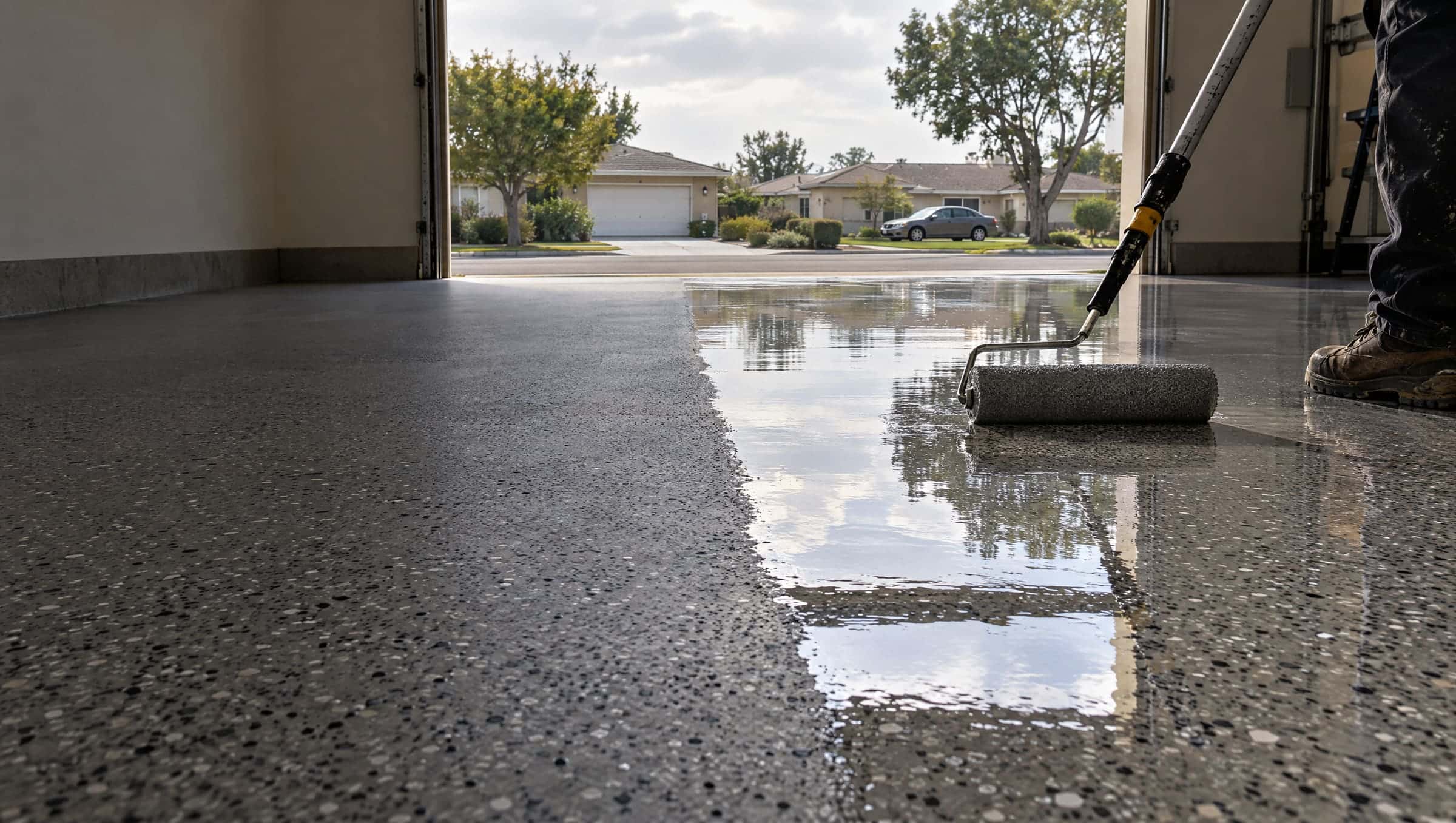
Polyaspartic is less forgiving to install, which is the main reason not every installer offers it. Once mixed, a typical garage polyaspartic gives a crew about 15 to 45 minutes of working time, and less on a warm or humid day. It also sets up on the floor much faster than epoxy, so there is little time to fix a lap line. Rushed batches show up as roller marks, bubbles and dry edges that cure in place.
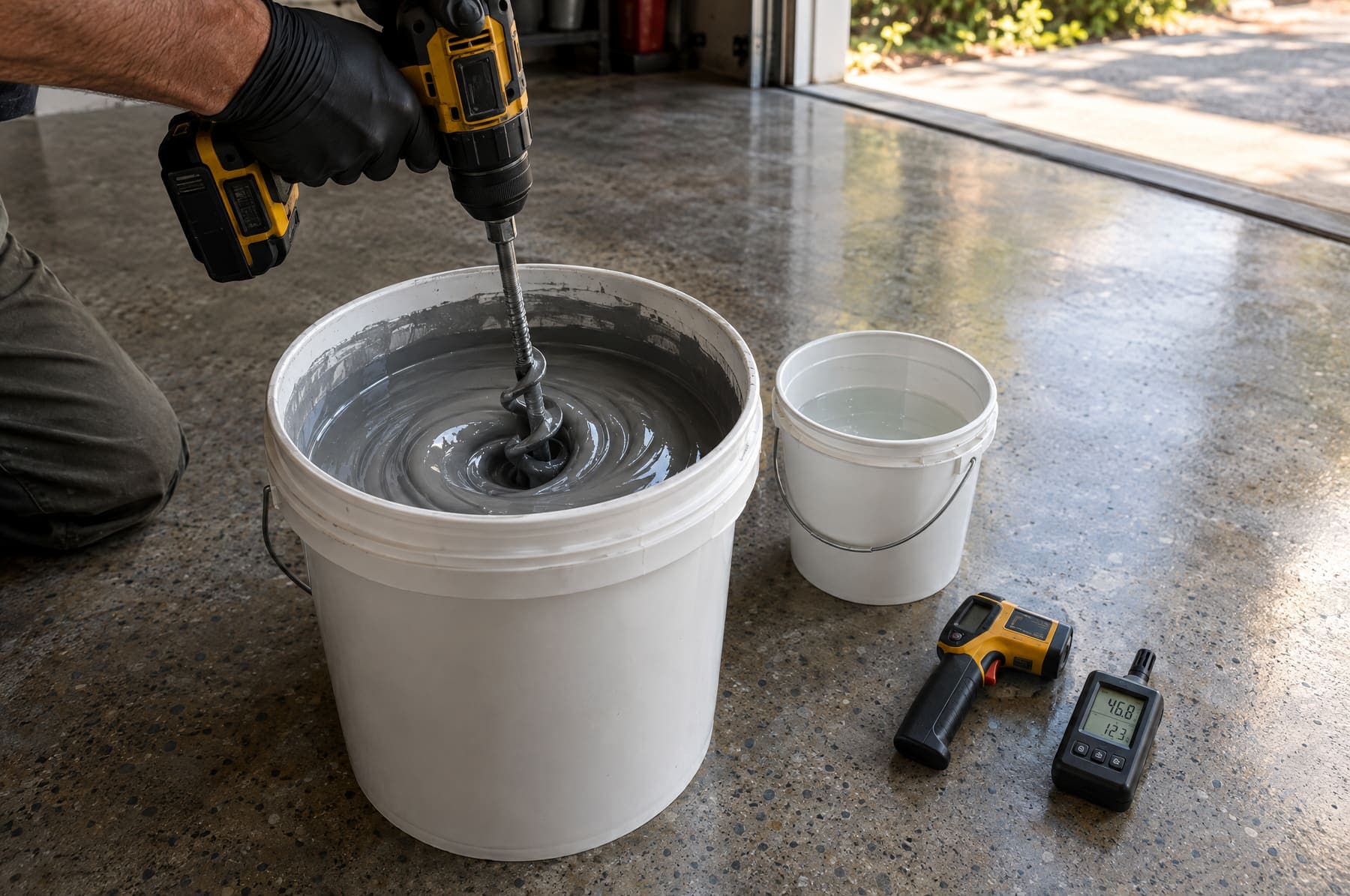
Heat and humidity shorten working time
- Polyaspartic, dry air (20% humidity)
- Polyaspartic, marine air (80% humidity)
Dew point and the marine layer
Coatings should go down only when the slab is at least 5°F warmer than the dew point. Closer than that, moisture can condense on the concrete and cloud the coating or weaken its bond. Polyaspartic is also moisture-reactive: humid air speeds its cure, and several data sheets say not to apply it above about 80 to 85% relative humidity. Summer mornings at Lindbergh Field average 81 to 82% (Western Regional Climate Center), so coastal installs often wait for the marine layer to lift. Try the numbers yourself.
Is it safe to coat? Dew point check
Too close. The slab is only 1.6°F above the dew point; wait for it to warm or for the air to dry. Humidity is above 80%, too: several polyaspartic data sheets say to wait for drier air.
Epoxy has its own humidity problem. In cold, damp air its hardener can react with moisture and carbon dioxide to leave a waxy film called amine blush, which weakens the bond of the next coat if it isn't washed off. Neither chemistry likes a wet morning; they just fail in different ways.
Moisture coming up through the slab
Concrete breathes. Older slabs, and slabs poured without a vapor barrier, can push moisture vapor up into a coating and blister it from below. Standard epoxy and polyaspartic both need a fairly dry slab: data sheets commonly cap it at about 3 pounds per 1,000 square feet per day on a calcium chloride test (ASTM F1869) or 75% relative humidity inside the slab (ASTM F2170). What epoxy has that polyaspartic doesn't is a family of moisture-mitigating primers, some rated for in-slab humidity up to 99%. So when a slab tests high, the usual answer is a mitigating epoxy primer with polyaspartic on top.
The hybrid: epoxy base, polyaspartic top
You don't have to pick a side. A hybrid system uses epoxy where epoxy is strongest, against the concrete, and polyaspartic where it is strongest, facing the sun and the tires.
- Base: 100% solids epoxy for bond and build, or a moisture-mitigating epoxy primer if the slab tests high.
- Middle: a full broadcast of vinyl flake for color, texture and grip.
- Top: one or two clear polyaspartic coats for UV stability, gloss and abrasion resistance.
The trade-off is time. The epoxy base has to cure before the topcoat goes on, so a hybrid usually takes two days instead of one. Over a damp slab, or in a garage that faces the afternoon sun, that extra day buys a lot.
Already have an epoxy floor? Polyaspartic can often go over it, as long as the old coating is sound, well bonded and sanded (data sheets typically call for 60 to 80 grit) so the new coat can grip. A floor that is peeling or bubbling has to come off first. Going the other way is harder: at least one manufacturer requires non-epoxy topcoats to be ground off before new epoxy goes down.
Which is right for your garage?
Answer four questions to see which system usually fits. It's a starting point, not a quote: the slab inspection and moisture test decide the final recommendation.
Find your system in four questions
01Does direct sun reach the floor?
02How soon do you need to park again?
03What is the slab like?
04What matters most?
Answer all four to see which system usually fits. Nothing is sent anywhere until you ask for an estimate.
Common San Diego situations
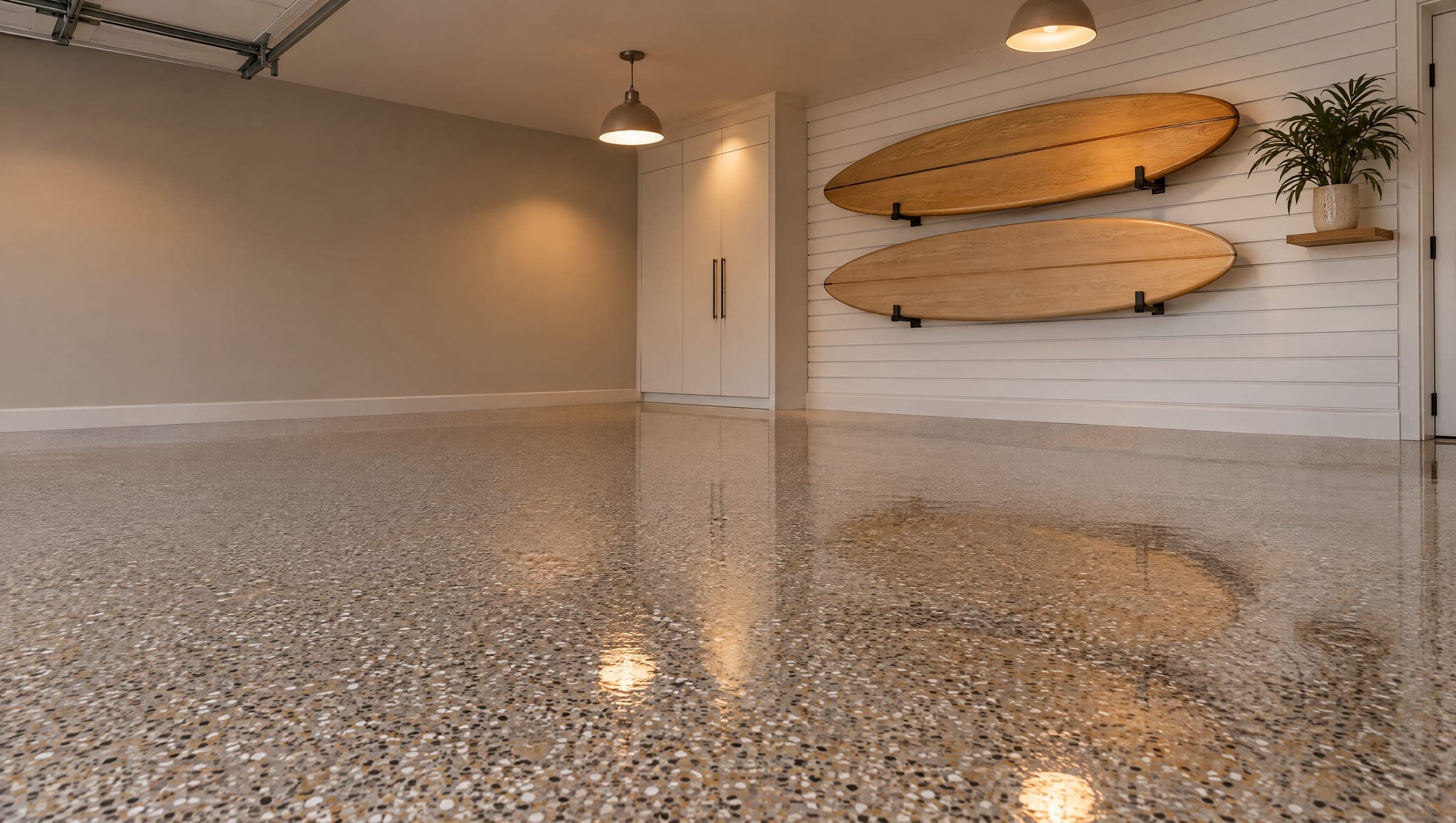 Hybrid or full polyaspartic
Open garage near the coast
Point Loma, Coronado, La Jolla
Doors open for hours and afternoon light across the floor. A polyaspartic topcoat keeps the blend from ambering; check the dew point on gray mornings.
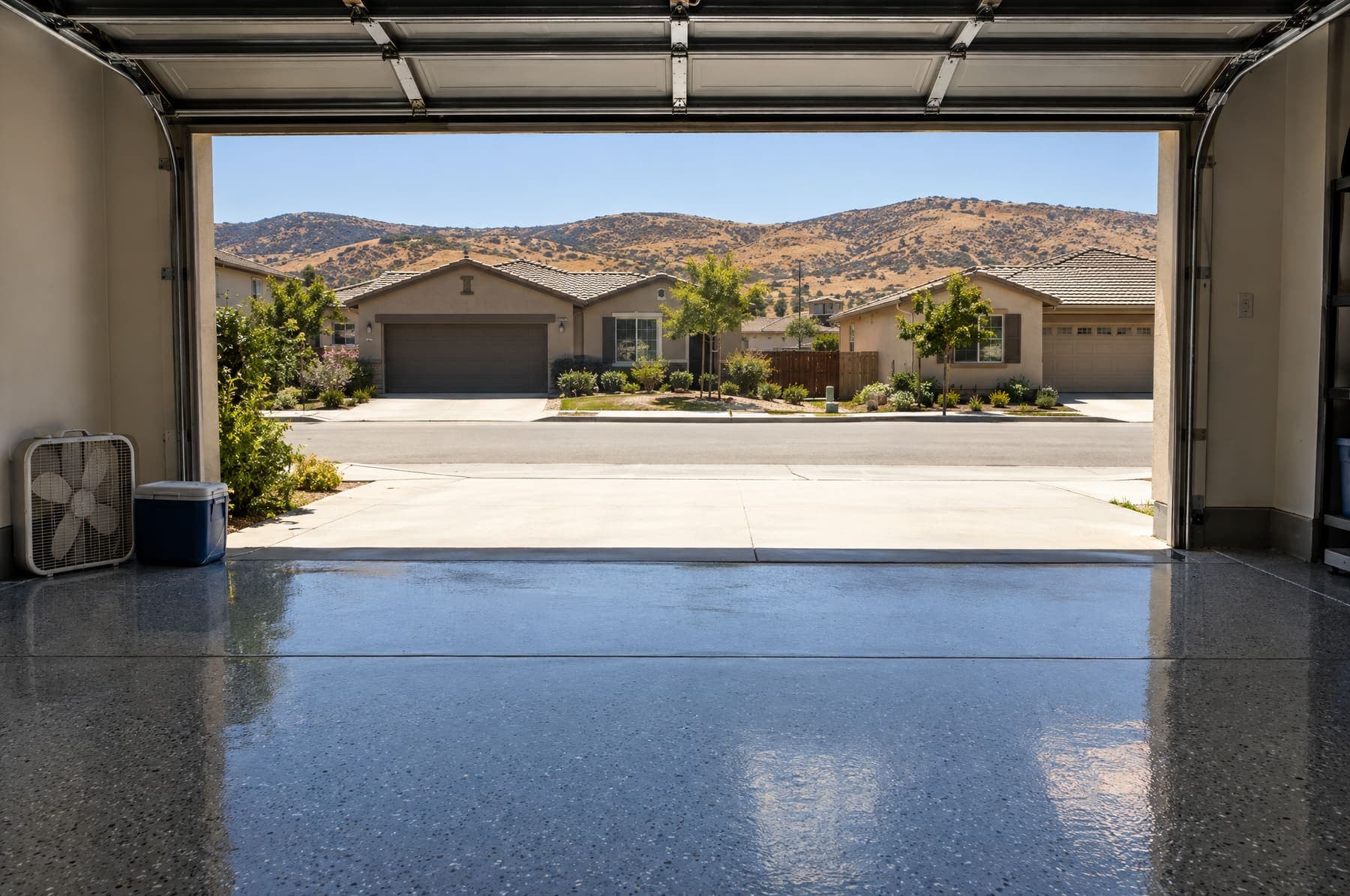 Polyaspartic top, early start
Inland heat
Rancho Santa Fe, Carmel Valley
Hot slabs cut polyaspartic working time sharply. Crews start early, mix smaller batches or use a slower formula, and keep the UV-stable topcoat.
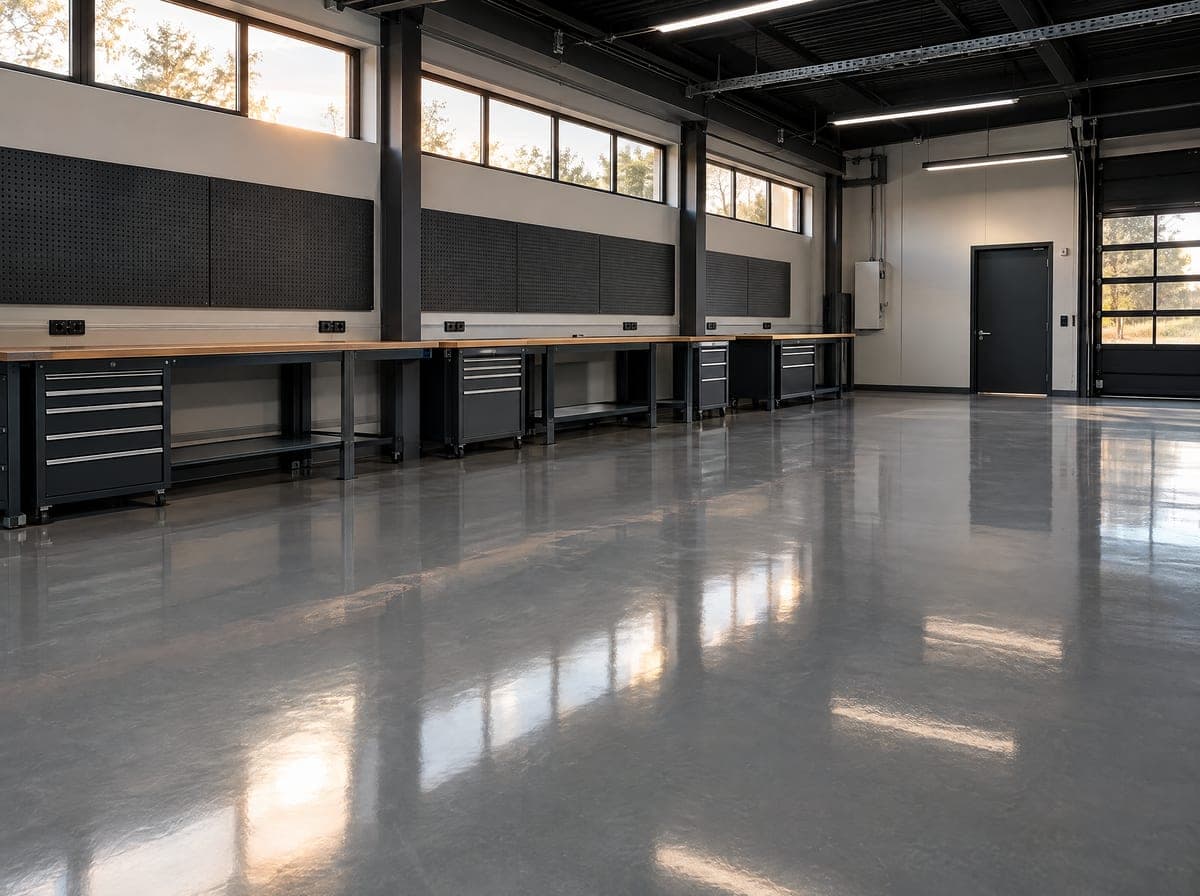 Full epoxy is good value
Closed garage, gym or workshop
Anywhere the sun never reaches
Out of direct light, epoxy's yellowing barely matters and its build and lower cost shine. Add polyaspartic only if you want the fastest return.
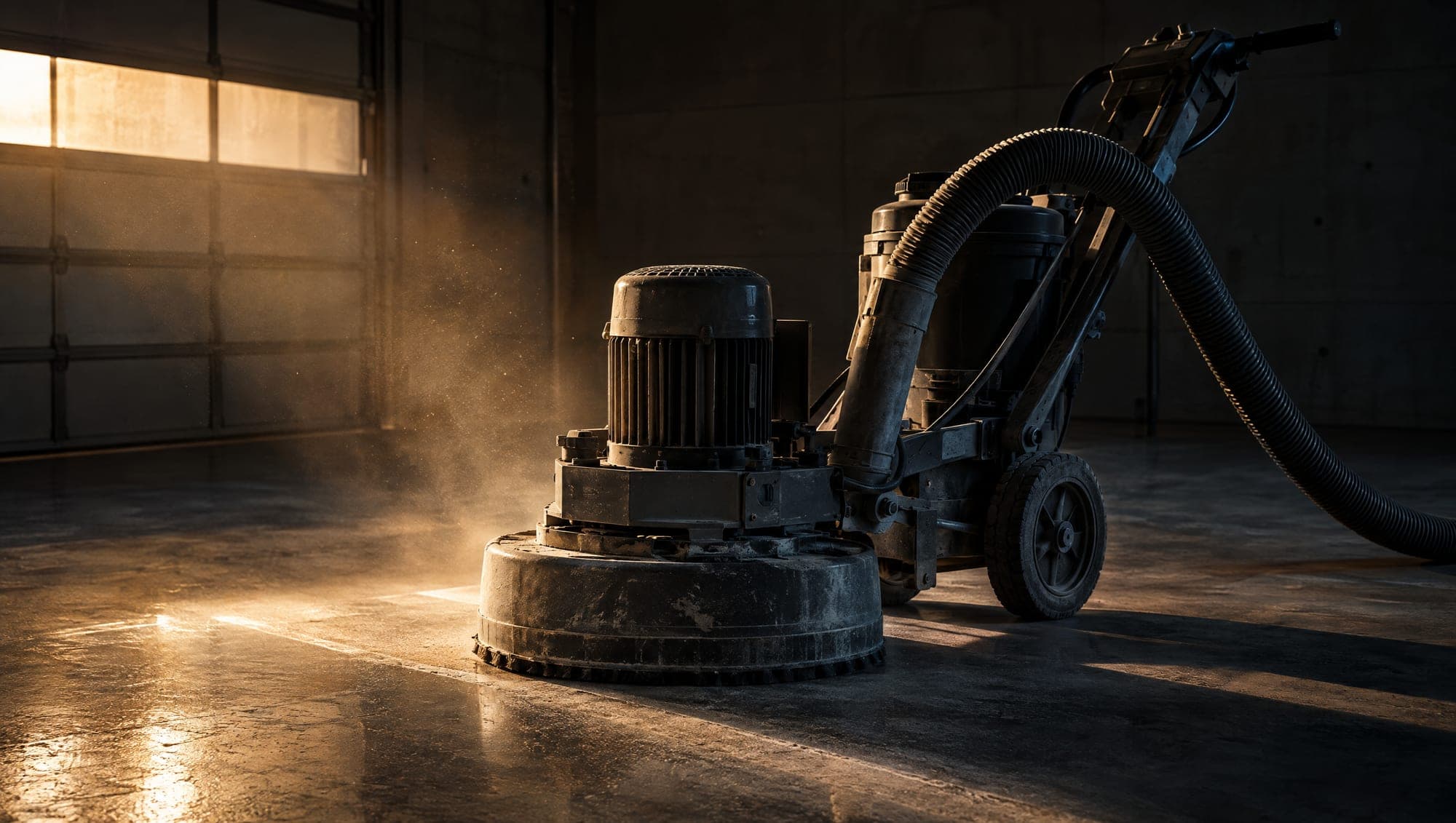 Mitigating epoxy primer, polyaspartic top
Older slab with damp spots
Mid-century homes, no vapor barrier
Test first. A moisture-mitigating epoxy primer holds vapor back, and the polyaspartic topcoat still handles sun and tires.
Sources and further reading
- ICRI Guideline 310.2R: Selecting and Specifying Concrete Surface Preparation for Sealers, Coatings and Polymer Overlays
- ASTM F1869: Moisture vapor emission rate using anhydrous calcium chloride
- ASTM F2170: Relative humidity in concrete floor slabs using in situ probes
- Covestro: polyaspartic coating technology
- American Coatings Association: UV resistance of epoxy systems (CoatingsTech, 2024)
- Sherwin-Williams: why acid etching is no longer recommended for concrete prep
- KTA-Tator: causes, detection and removal of amine blush
- Example data sheet: Simiron Polyaspartic HS
- Example data sheet: Simiron 1100SL epoxy
- San Diego APCD Rule 67.0.1: Architectural coatings
- Western Regional Climate Center: average relative humidity by city
- EPA: monthly average UV index, 2006 to 2023
Written by San Diego Epoxy & Concrete. Prices are typical San Diego ranges from our cost guide, not quotes. Images are illustrations, not photos of our projects.