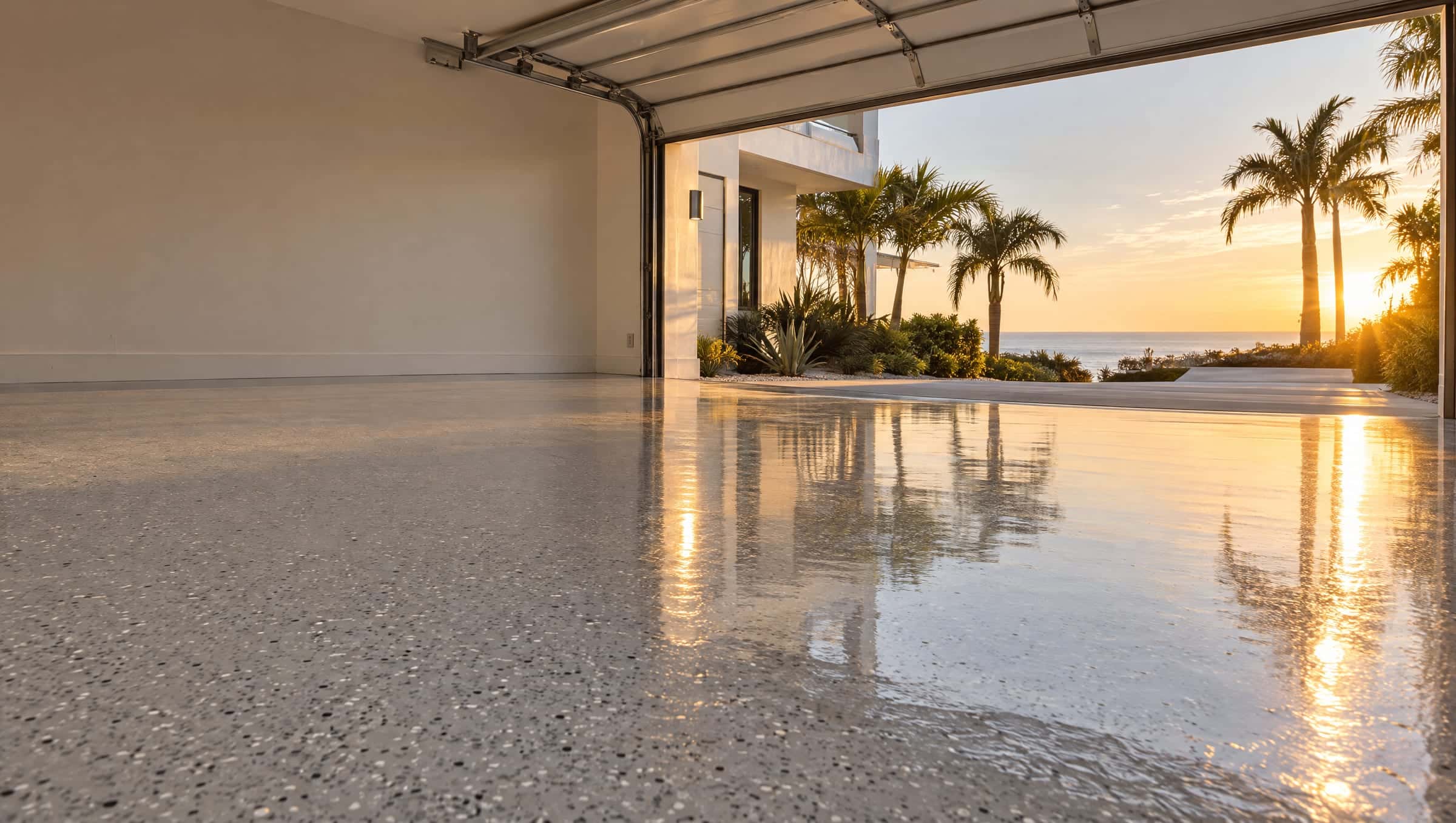
Polyaspartic Floor Coatings in San Diego
A fast-curing topcoat and full-system option for garages and sun-facing floors. It holds its color in direct light and typically takes vehicles again within 24 to 48 hours.
- Free on-site estimateMoisture test included
- Diamond-ground prepBonds into the slab
- UV-stable topcoatsBuilt for coastal sun
- Carlsbad to CoronadoService area
About polyaspartic coatings
A polyaspartic floor coating is a two-part, UV-stable coating that cures in hours instead of days. Chemically it is an aliphatic polyurea, which is why it does not yellow in sunlight the way epoxy does. In San Diego garages it usually serves as the clear topcoat over a flake or metallic floor, and it can also run the full system, from base coat to finish.
The appeal is easy to see. Walk-on time is typically 4 to 6 hours, cars are typically back in 24 to 48 hours, and the surface stays clear and glossy where the sun lands on it. Epoxy still earns a place, often as the base coat underneath. The epoxy vs polyaspartic comparison below shows where each one wins.
There are trade-offs, and we would rather you hear them from us. Polyaspartic has a short working time, so it needs an experienced crew, careful batch sizes, and a sound, dry slab. It also costs more than basic epoxy. For an open garage near the coast, the UV stability and speed usually justify it.
Why homeowners and businesses choose it
Stays clear in direct sun
Polyaspartic is aliphatic, so UV does not break it down into the amber cast that plain epoxy develops. Gray flake stays gray and a white base stays white, even in a garage that sits open to the afternoon light. That is why it is the standard topcoat for any floor the sun can reach.
Back in service in a day or two
Foot traffic typically returns in 4 to 6 hours, and light vehicles can usually park again within 24 to 48 hours, depending on the product and temperature. For a household with one garage and two cars, that is the difference between a weekend of disruption and a week of parking on the street.
A polyaspartic floor coating as the wear layer
The clear top layer is what tires, tools, and spills actually touch. Polyaspartic cures hard and resists abrasion, hot-tire pickup, and common garage fluids such as oil and antifreeze. It can be tinted, built in one or two coats, and finished in gloss or satin, with an anti-slip additive where you want more grip.
The honest trade-offs
Once mixed, polyaspartic often gives a crew 15 to 45 minutes to work, less on a hot day, so rushed installs show roller marks and bubbles. It needs a dry, well-ground slab, and the material costs more than epoxy. We plan batch sizes, crew roles, and timing around those limits before the first coat goes down.
What goes into the system
| Spec | Typical |
|---|---|
| Chemistry | Aliphatic polyurea (polyaspartic ester resin plus an aliphatic isocyanate) |
| Typical system | Diamond-ground slab; epoxy, polyurea, or polyaspartic base; optional flake broadcast; one or two clear polyaspartic topcoats |
| Working time | Often 15 to 45 minutes after mixing; shorter in heat |
| Walk-on time | Typically 4 to 6 hours |
| Vehicle traffic | Typically 24 to 48 hours |
| UV stability | High; resists yellowing and gloss loss in direct sun |
| Finish options | Clear or tinted; gloss or satin; anti-slip additive available |
Ranges are typical and vary by formula. Some fast products allow foot traffic sooner, and full chemical resistance can take several more days. Your written estimate names the exact products and times.
How we install it
- 01
Inspection and moisture test
We walk the space, measure it, and look closely at the slab: cracks, spalls, old coatings, oil stains and drainage. Then we test for moisture vapor with a calcium chloride test or a relative humidity probe. The results decide the system, the primer and the prep, and they go into your written estimate.
- 02
Diamond grinding and surface prep
We grind the concrete with diamond tooling and dust collection to a consistent profile, typically CSP 2 to 3, about the feel of medium sandpaper. Grinding removes weak surface paste, old sealers and contamination, so the base coat bonds into the slab instead of sitting on top of it.
- 03
Crack and spall repair
Cracks, chips, spalls and pitting are filled with a polyurea or epoxy repair material and ground flush with the floor. Control joints are cleaned out and either filled or kept open, depending on the system. Repairs stop defects from showing through the finish and remove weak points where a coating could lift.
- 04
Base coat and broadcast
The base coat goes down: 100% solids epoxy, polyurea, or a moisture-mitigating primer where testing called for one. Flake floors get color chips broadcast to full coverage. Metallic floors get pigments worked by hand. Commercial floors may get a quartz broadcast. Loose material is scraped and vacuumed once the base cures.
- 05
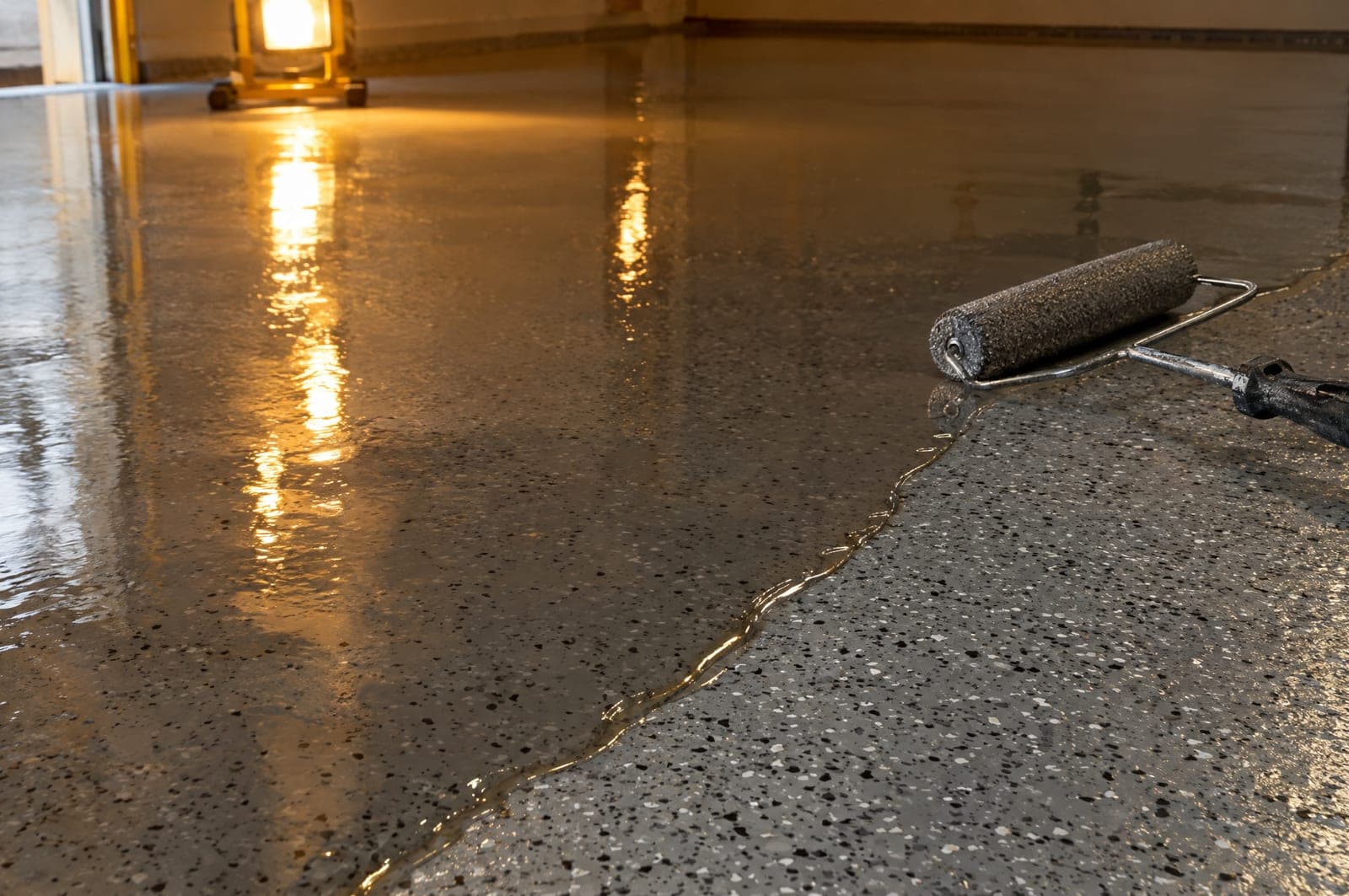
UV-stable topcoat, cure and return to service
A clear polyaspartic or polyurea topcoat seals the floor, sets the sheen and resists UV yellowing, with slip-resistant texture available. Foot traffic typically returns within about 24 hours. Vehicles typically wait 24 to 48 hours on polyaspartic systems and 3 to 7 days on epoxy, depending on product and temperature.
- We check slab temperature against the dew point before each coat. Coating a slab within about 5°F of the dew point risks condensation, cloudy patches, and a weak bond.
- Polyaspartic is mixed in small batches and rolled out in sections, with crew roles set before the first kit is opened, so every batch goes down well inside its working time.
- If the moisture test reads high, we start with a moisture-mitigating epoxy primer and put polyaspartic on top, rather than applying it straight to a damp slab.
Built for coastal sun, salt air, and moisture
Open garages and coastal light
A garage that doubles as a gym, workshop, or main entry often sits open for hours, and UV still reaches the floor through a thin marine layer. Epoxy topcoats yellow under that exposure. A polyaspartic topcoat keeps the floor's color stable, which matters most for lighter flake blends and for west-facing doors that take the afternoon sun.
Humidity and marine-layer mornings
Humidity changes how polyaspartic cures. Damp air can shorten working time, and a cold slab can pull condensation under the coating. On foggy coastal mornings we measure slab temperature and dew point, start later when the numbers call for it, and size batches to the conditions that day rather than to the ideal on the label.
Older slabs and moisture vapor
Polyaspartic tolerates moisture vapor less well than a mitigating epoxy primer does. Older slabs, especially ones poured without a vapor barrier, can push enough moisture through to blister a coating from below. We test with a calcium chloride kit or an in-slab RH probe and build the system around the reading.
Polyaspartic vs epoxy
| Polyaspartic | Epoxy | |
|---|---|---|
| UV stability | Aliphatic; resists yellowing in direct sun | Ambers with UV exposure unless topcoated |
| Return to service | Walk-on typically 4 to 6 hours; vehicles 24 to 48 hours | Walk-on typically about 24 hours; vehicles 3 to 7 days |
| Working time | Short, often 15 to 45 minutes | Longer and more forgiving |
| Build per coat | Thinner coats; relies on a well-ground slab | Builds thickness quickly; bonds strongly to ground concrete |
| Moisture tolerance | Low; needs a dry slab or a mitigating primer | Moisture-mitigating epoxy primers are available |
| Typical cost | Higher material and labor cost | Lower |
| Best role | Topcoat or full system wherever sun reaches the floor | Base coat, or indoor floors out of the sun |
What polyaspartic coatings costs in San Diego
Polyaspartic adds to material and labor, so systems built around it tend to sit in the upper half of the typical San Diego range of about $5 to $8 per square foot for a professional garage floor. Our cost guide shows how system choice, slab repair, and garage size change the total.
Polyaspartic Coatings questions
Compare other floor systems
Garage Floor Epoxy
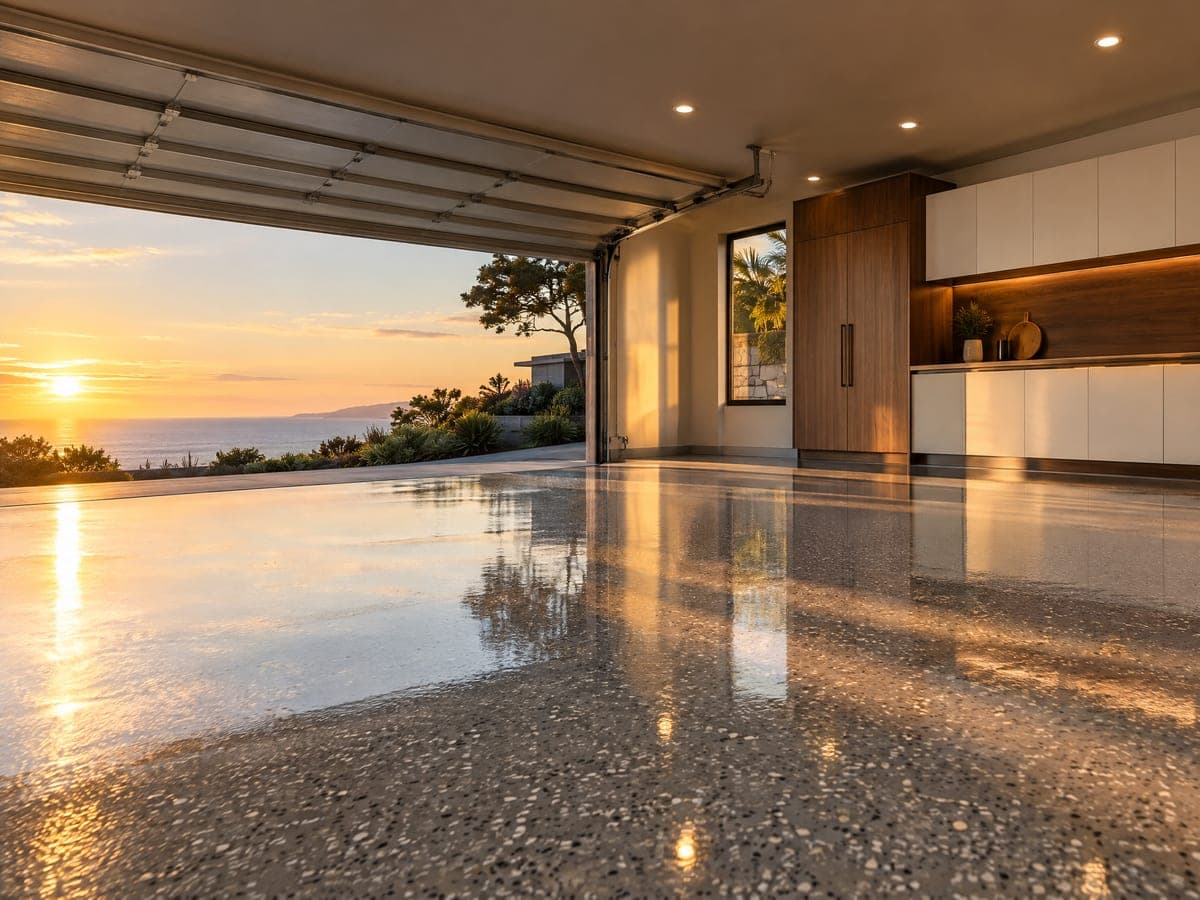
Diamond-ground, multi-layer garage floor systems with flake or metallic finishes and a UV-stable topcoat, built for coastal sun, salt air, and hot tires.
Learn more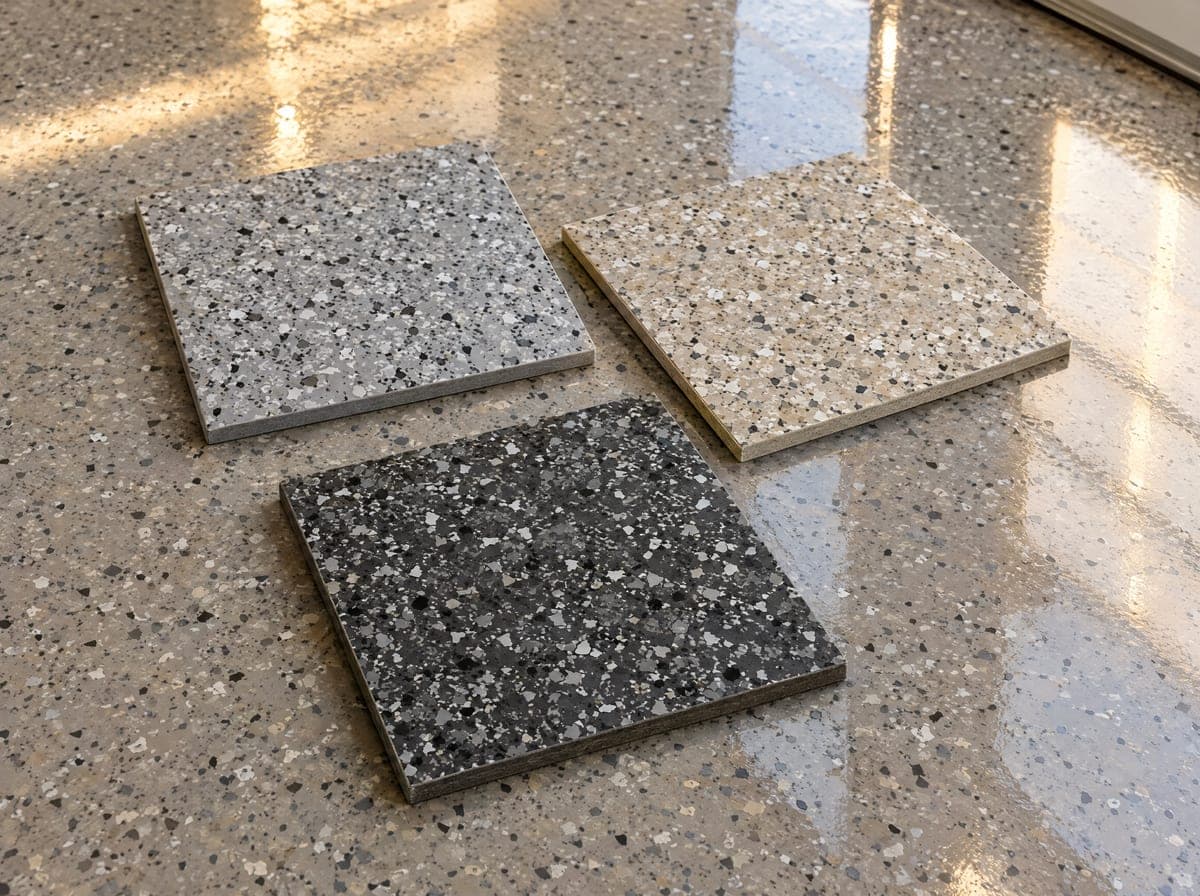
Flake Epoxy Floors
Full-broadcast vinyl flake under a UV-stable clear coat: textured for grip, forgiving of dust and slab flaws, in color blends chosen to suit your home.
Learn more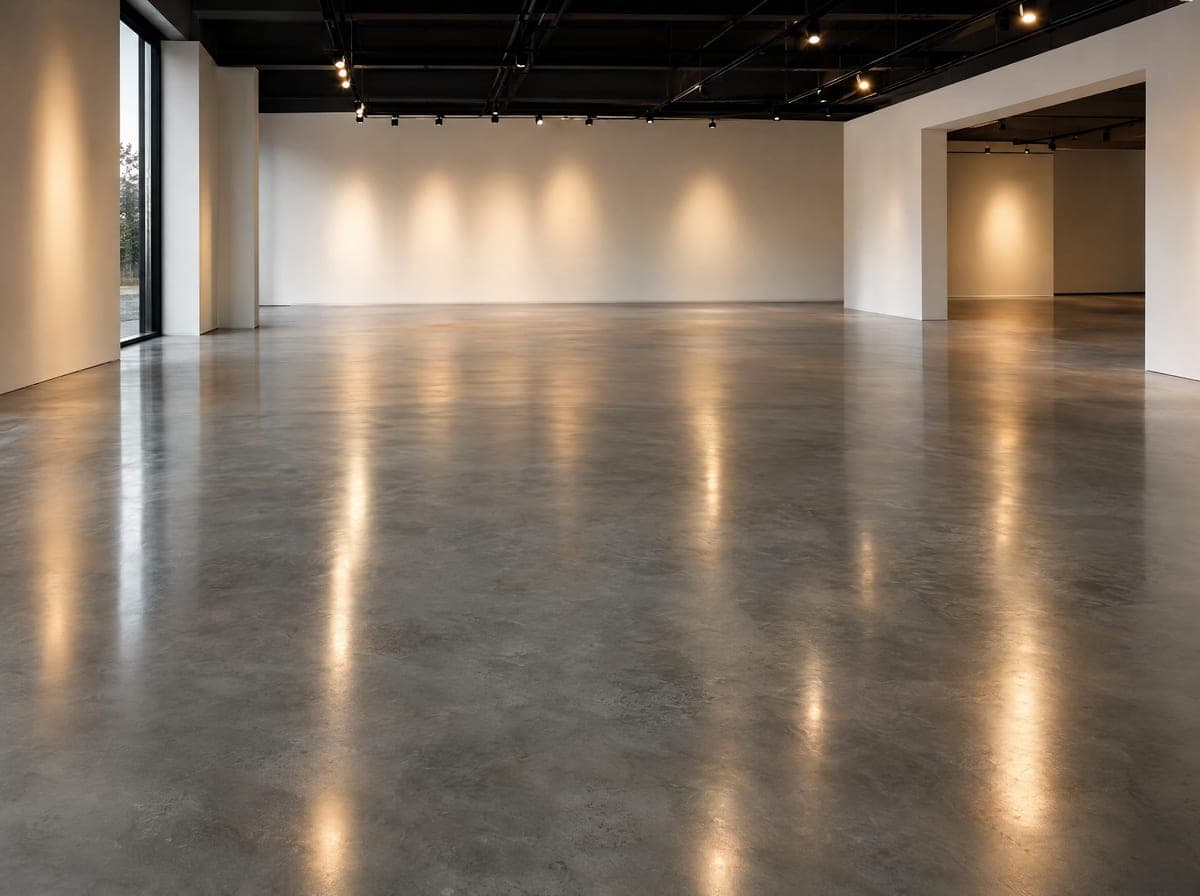
Concrete Polishing
Diamond-ground, densified, and guarded concrete floors from matte to high gloss for modern homes, ADUs, garages, showrooms, retail, and warehouses.
Learn morePolyaspartic Coatings across San Diego
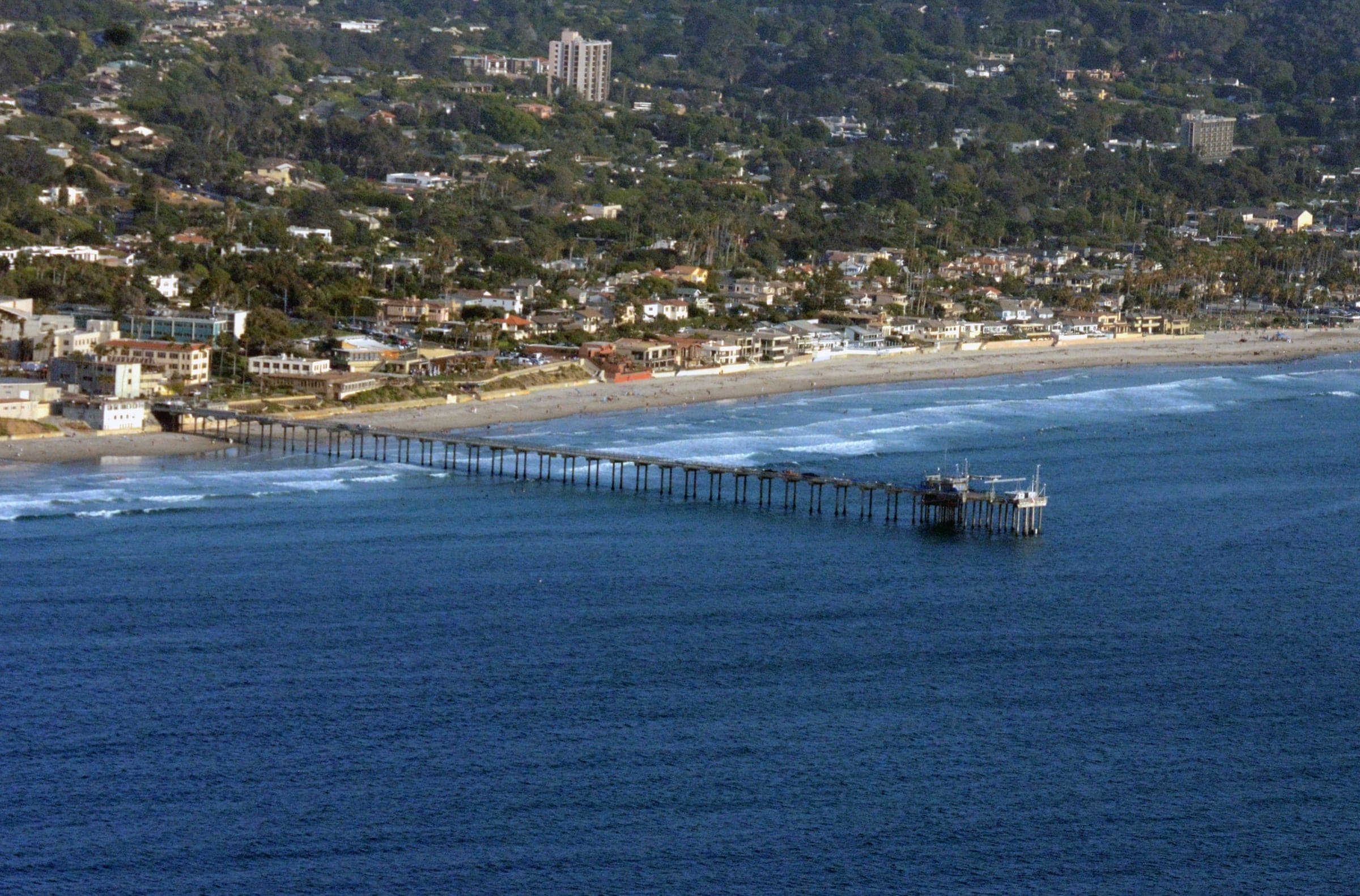
La Jolla
Garage floor epoxy and polyaspartic coatings for La Jolla homes, built for salt air, marine-layer mornings and strong coastal sun, from Bird Rock to La Jolla Farms.
Epoxy floors in La Jolla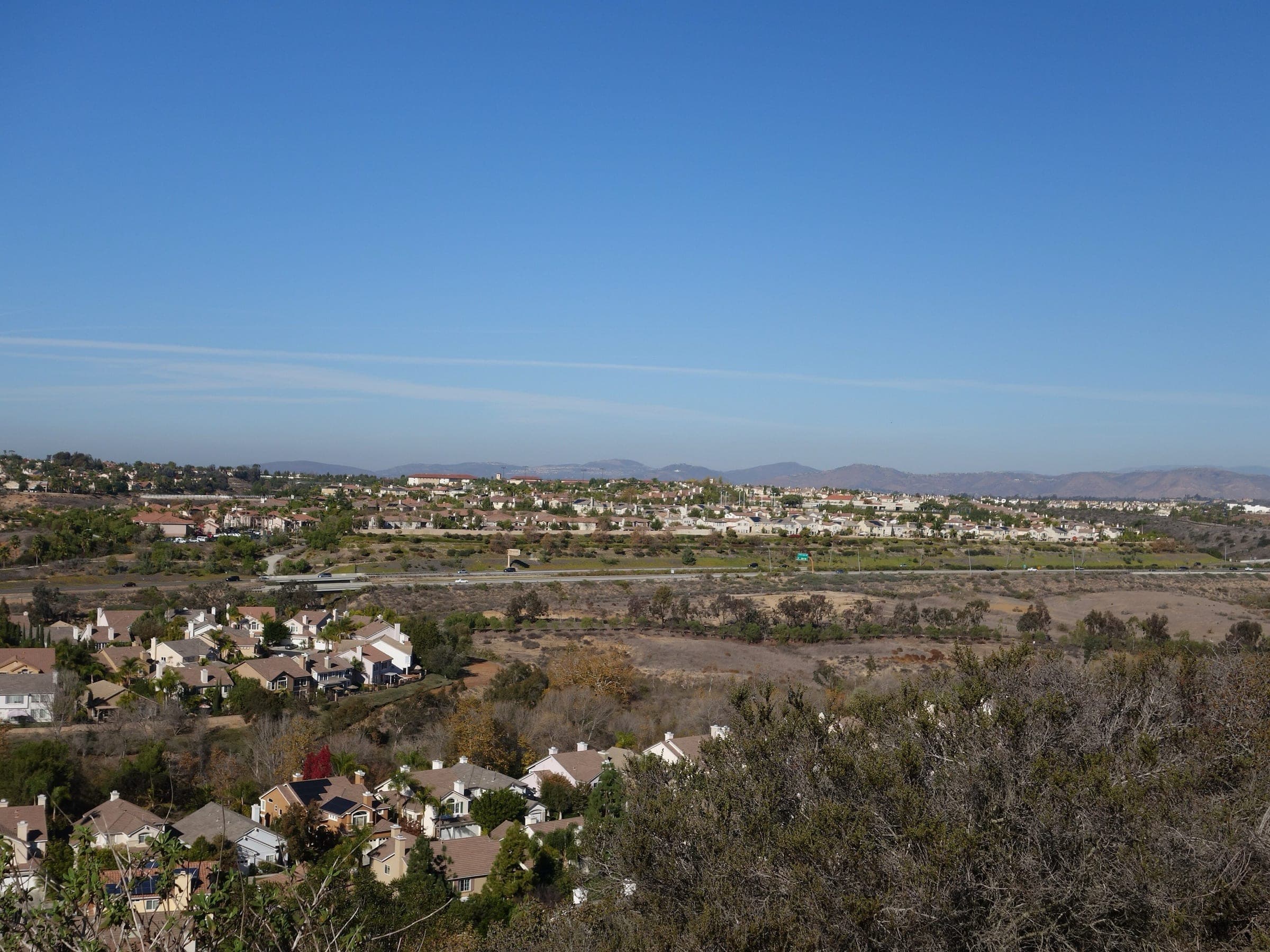
Carmel Valley
Flake and polyaspartic garage coatings for Carmel Valley, Pacific Highlands Ranch and Torrey Hills homes, with full removal of old coatings and HOA submittal support.
Epoxy floors in Carmel Valley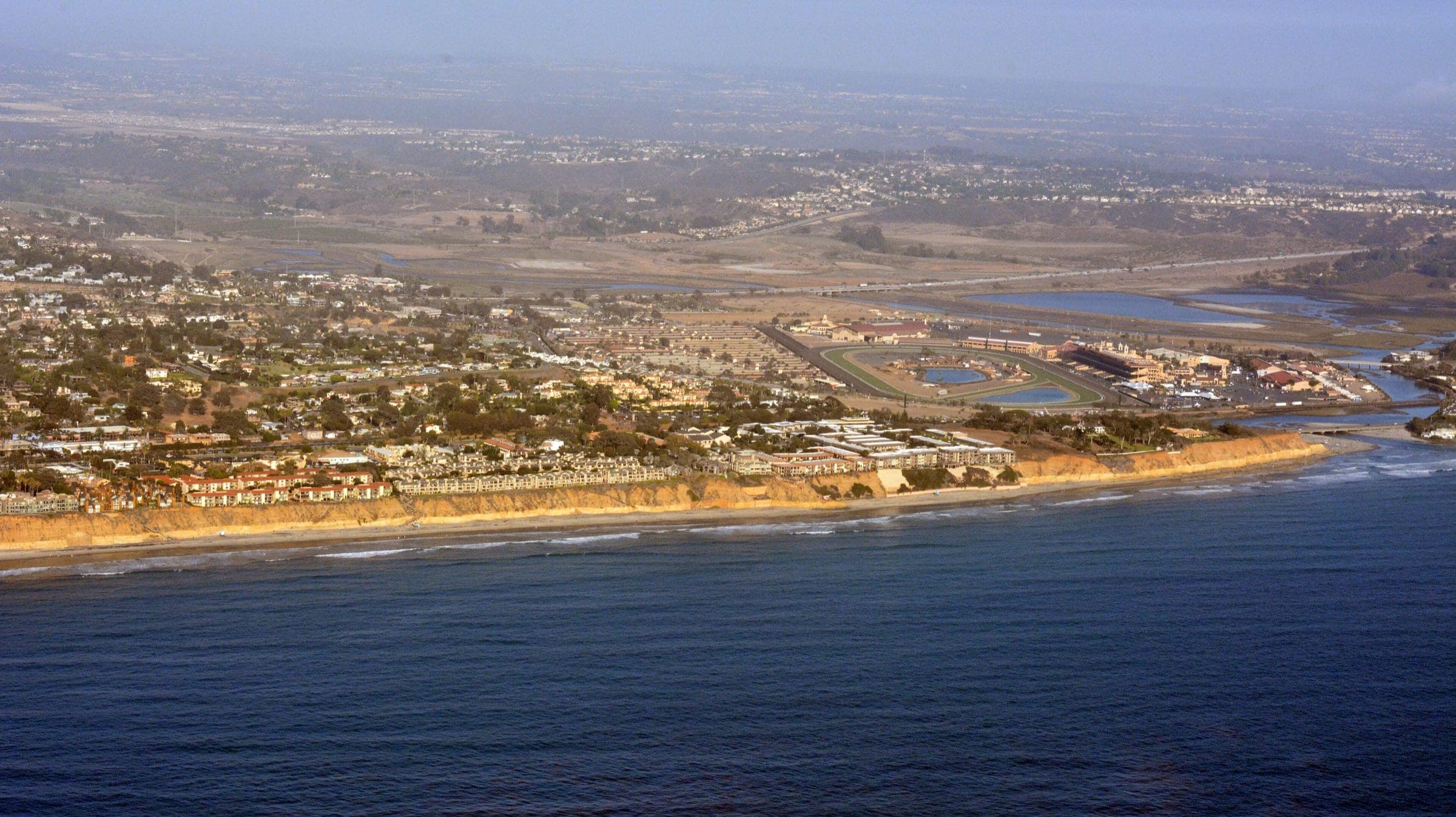
Del Mar
Garage coatings and concrete resurfacing for Del Mar and Solana Beach, with moisture testing for low-lying slabs and UV-stable topcoats for salt air.
Epoxy floors in Del Mar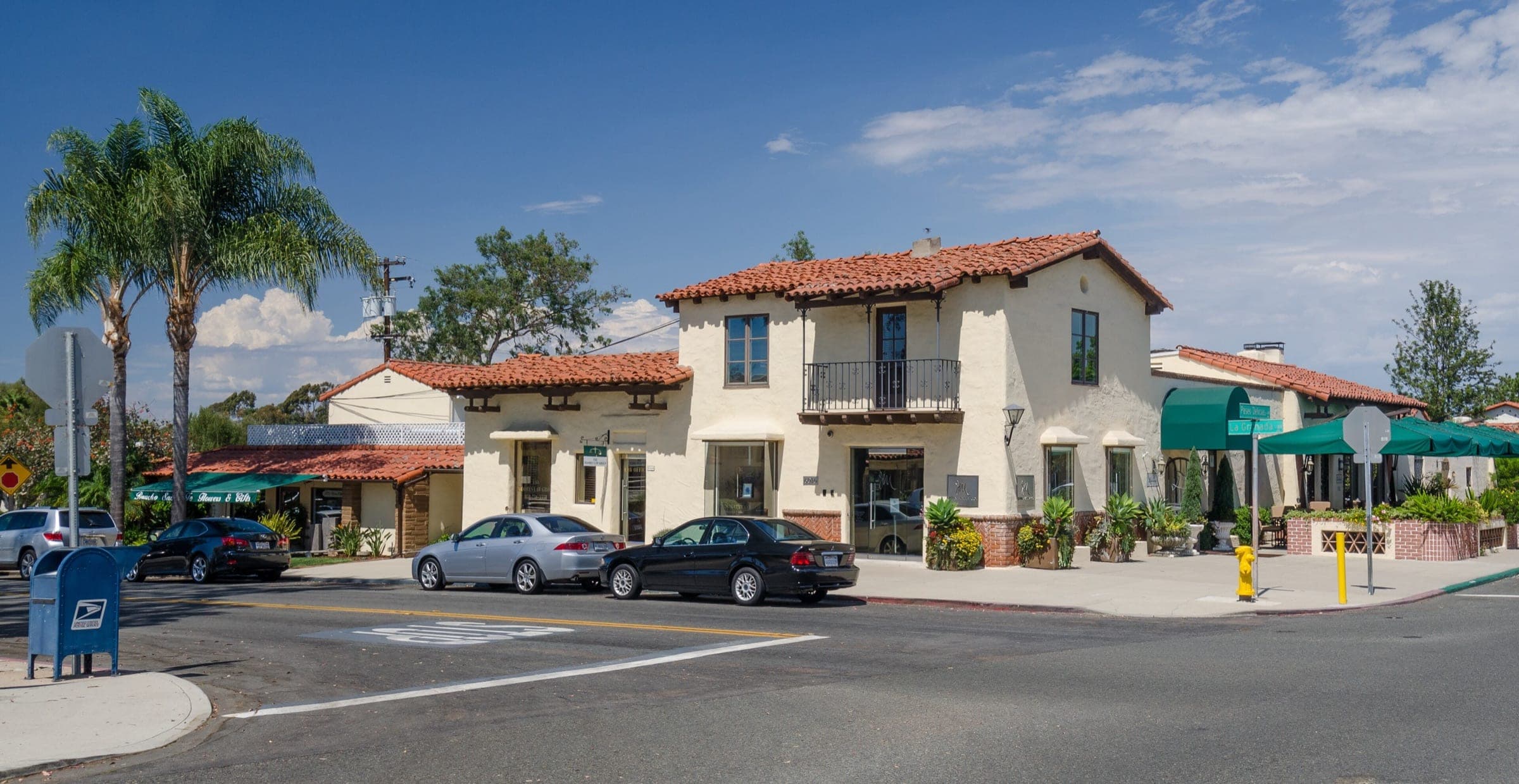
Rancho Santa Fe
Garage floor epoxy, metallic finishes and pool deck resurfacing for Rancho Santa Fe estates, with prep for inland heat and product details for Art Jury review.
Epoxy floors in Rancho Santa Fe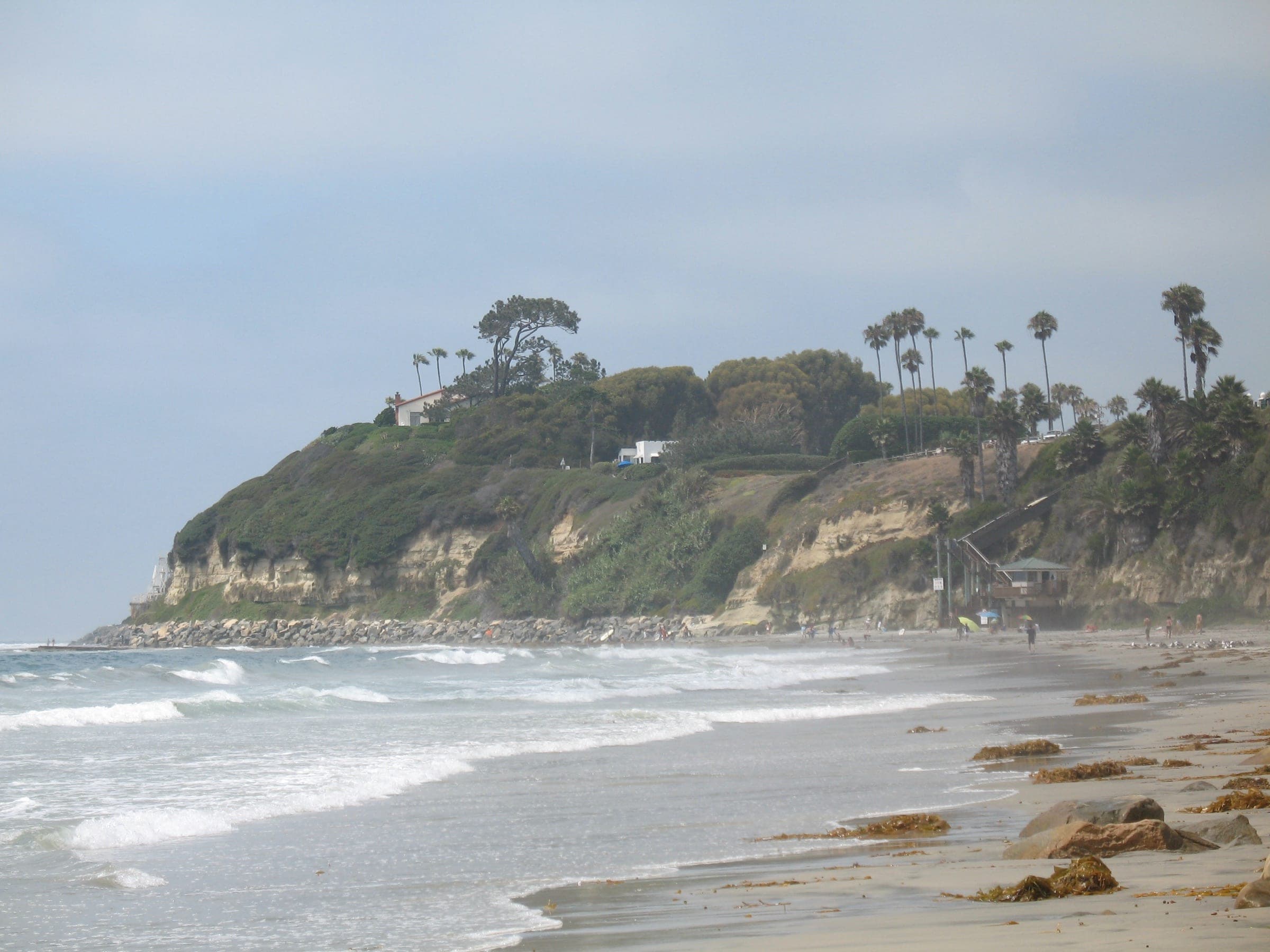
Encinitas
Encinitas garage, patio, and pool deck coatings matched to each community: salty bluff-top air in Leucadia and Cardiff, stronger sun in Olivenhain.
Epoxy floors in Encinitas
Carlsbad
Garage floor systems for La Costa, Aviara, Bressi Ranch, and the Village, plus commercial epoxy and polished concrete for Carlsbad's business parks.
Epoxy floors in Carlsbad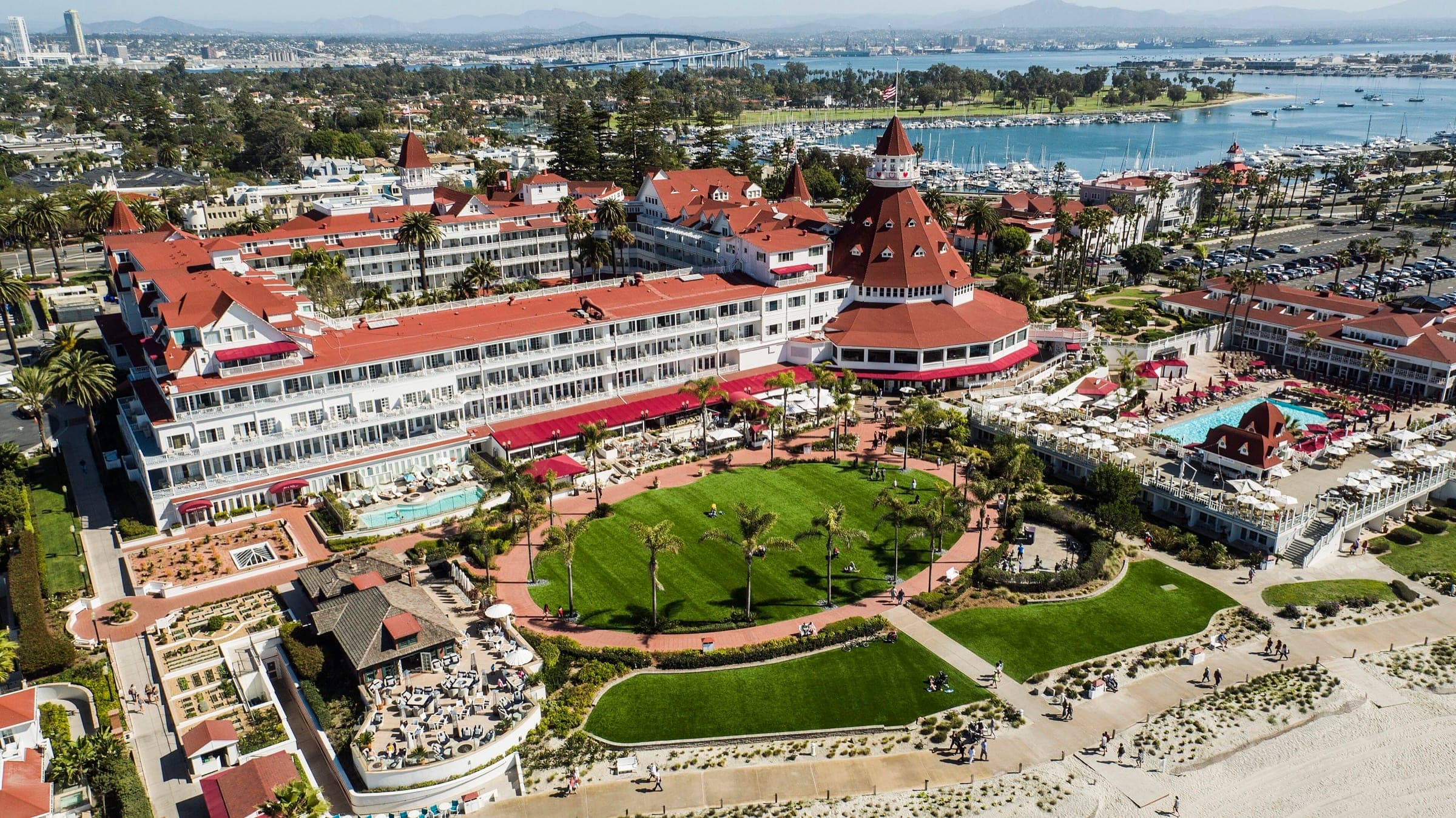
Coronado
UV-stable, moisture-tested floor systems for Coronado's alley garages, bayfront Cays homes, and salt-weathered patios and courtyards.
Epoxy floors in Coronado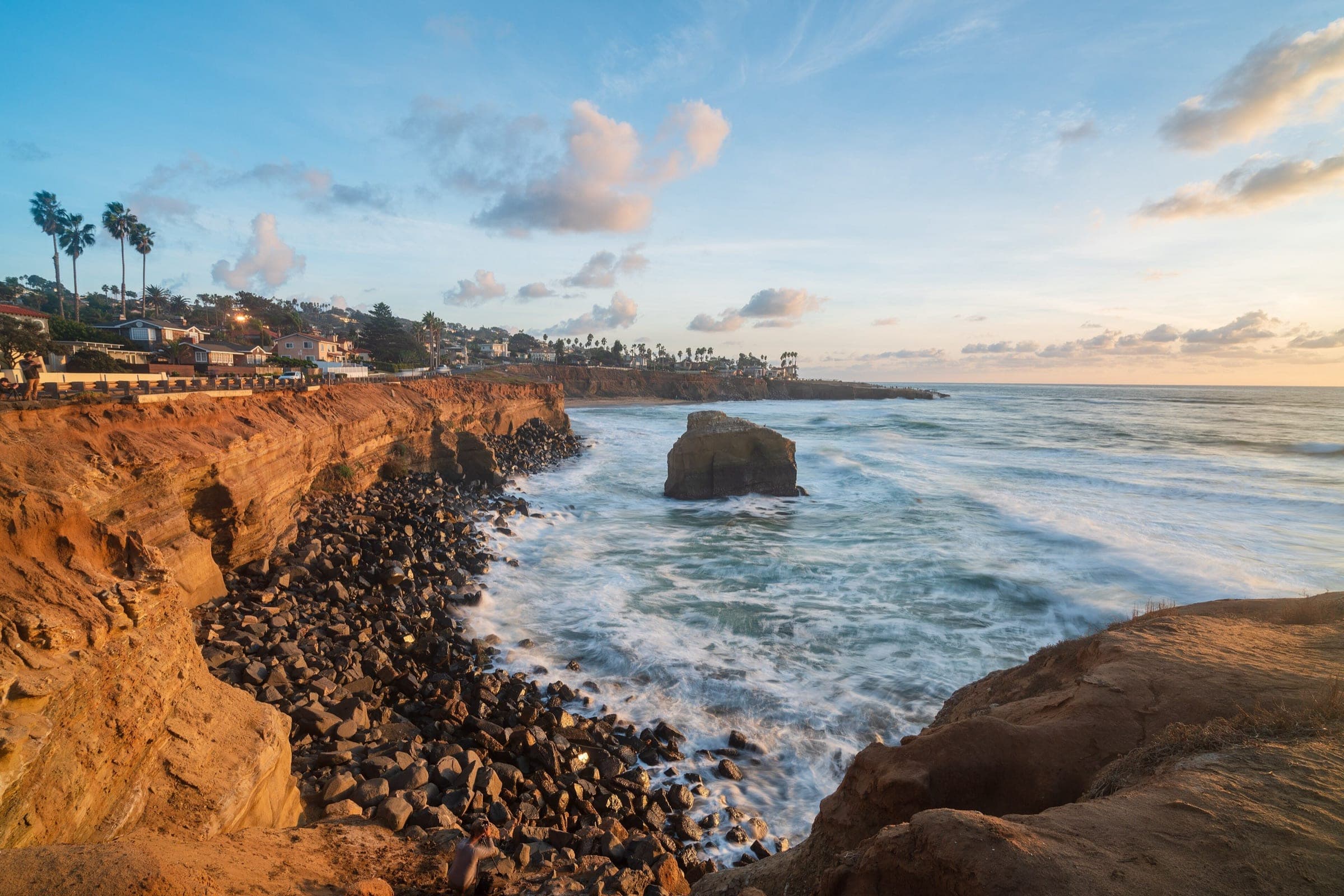
Point Loma
Coatings for Point Loma garages, driveways, and patios, from Sunset Cliffs and the Wooded Area to La Playa and Fleetridge, built for salt air and slopes.
Epoxy floors in Point Loma
Get a polyaspartic coatings estimate
Tell us about the space. We will inspect the slab, test for moisture, and recommend the right system with a written estimate.